
AI Agent Governance Checklist
Define the operating boundaries before granting the system authority
Use this worksheet Complete, copy or print
AI Agent Governance Worksheet
Record your answers below. Draft recovery uses this browser on this device. Clear it when you finish, especially on a shared device.
Governance is not a policy document added after deployment. It is the set of technical and operating decisions that determine what an agent may access, what it may do, when it must stop, and who remains accountable.
AI Agent Governance Checklist
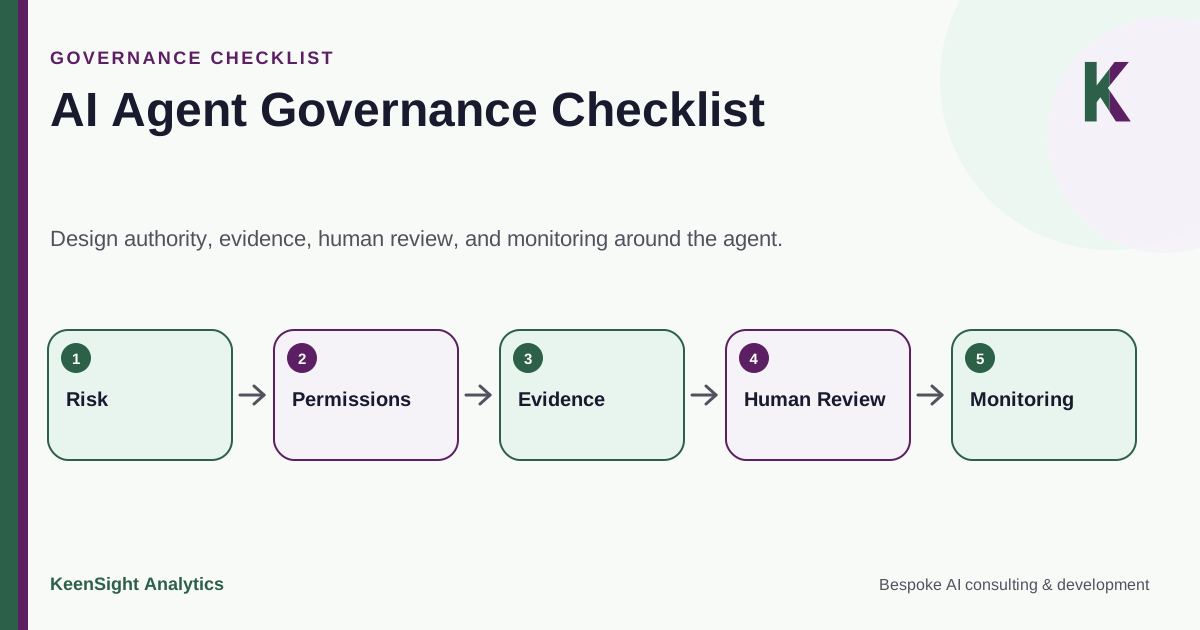
Design authority, evidence, human review, and monitoring around the agent.
- Risk
- Permissions
- Evidence
- Human Review
- Monitoring
Governance Questions
Authority
List every action the agent can perform. Separate read-only access, recommendations, draft creation, external communication, system updates, approvals, financial actions, and irreversible changes. Give the first release the minimum authority it needs.
Human review
Define which actions always require approval and which can proceed automatically under specific conditions. Document the reviewer role, information presented for review, and what happens when a reviewer rejects or edits the proposed action.
Data access
Identify the data sources the agent may access, the fields it actually needs, and whether sensitive categories require additional controls. Use least-privilege credentials and avoid broad access simply because it is technically convenient.
Knowledge sources
Define which repositories are authoritative, who owns them, how stale content is identified, and what the agent should do when sources conflict or no approved answer exists.
Evaluation
Create test cases for normal work, edge cases, ambiguous inputs, missing data, adversarial or malformed inputs, integration failures, and policy-sensitive scenarios. Measure appropriate behavior and escalation, not only task completion.
Logging and auditability
Record enough information to understand what the system received, what tools or sources it used, what action it proposed or took, what rules were applied, and whether a person reviewed the result. Avoid logging sensitive content that is not necessary for the audit purpose.
Failure behavior
Define safe outcomes when a model, API, credential, data source, or downstream system fails. The agent should be able to stop, retry within limits, queue work, or escalate rather than improvising around missing dependencies.
Change control
Treat prompt changes, model changes, tool permissions, routing rules, knowledge-source changes, and integration changes as production changes. Define testing and approval requirements appropriate to their impact.
Operational ownership
Name the business and technical owners responsible for quality, access, incidents, source maintenance, exception policy, and periodic review. Governance needs an operating owner after launch.
When the checklist reveals decisions shared across initiatives, design the wider AI operating model around clear authority, review paths, and accountability.
Minimum Production Controls
Least Privilege
Use the narrowest practical credentials and action scopes for each integration.
Explicit Escalation
Define when low confidence, sensitive content, or policy exceptions must reach a human.
Traceable Sources
Keep important generated decisions or drafts connected to the approved information that supported them.
Bounded Retries
Prevent failed tool calls or workflow loops from retrying indefinitely.
Testable Acceptance Criteria
Evaluate safe behavior, correct routing, and failure handling as well as task accuracy.
Change Management
Review material changes to models, prompts, tools, permissions, rules, and knowledge before production rollout.
Design Governance Into the Workflow
KeenSight can map the authority, controls, review gates, audit trail, and safe-failure behavior for a specific agent use case.
Continue with practical guidance
- AI Agent Evaluation: How to Test Production AI Systems
Build agent evaluations around representative tasks, verified outcomes, tool behavior, permissions, review quality, and production release evidence.
- AI Agent Security: Permissions, Prompt Injection, Tool Use, and Control
Secure AI agents with identity, permission-aware retrieval, narrow tools, validated actions, human approval, deployment controls, and operational tests.
- Production AI Launch Checklist: Evals, Security, Controls, and Monitoring
Use an on-page production AI launch checklist covering evaluation, authority, review, recovery, monitoring, rollout, and accountable ownership.