
Agentic AI vs RPA Decision Guide
Choose the automation model that matches the workflow
Use this worksheet Complete, copy or print
Automation Decision Worksheet
Record your answers below. Draft recovery uses this browser on this device. Clear it when you finish, especially on a shared device.
RPA, conventional workflow automation, AI-assisted workflows, and agents are different tools. The right choice depends on input variability, decision complexity, system interfaces, exception handling, and the authority the automation needs.
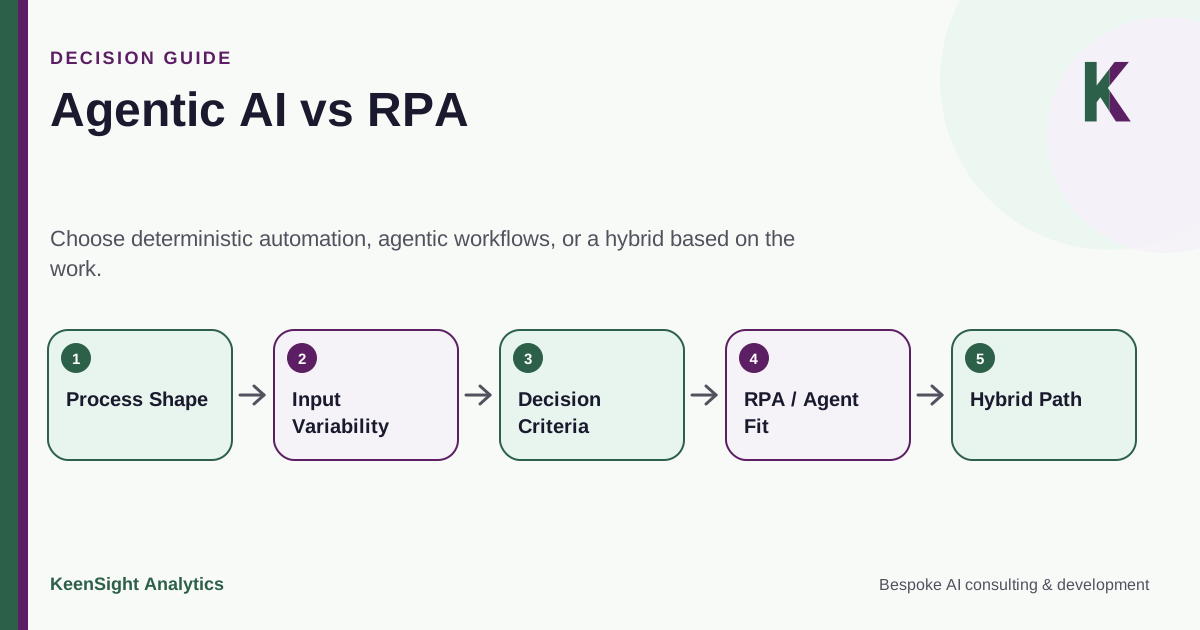
Agentic AI vs RPA
Choose deterministic automation, agentic workflows, or a hybrid based on the work.
- Process Shape
- Input Variability
- Decision Criteria
- RPA / Agent Fit
- Hybrid Path
Match the Tool to the Work
Scroll horizontally to see all columns.
| Feature | More Deterministic | More AI-Assisted |
|---|---|---|
| Inputs | Structured and predictable | Language, documents, mixed or variable inputs |
| Decision logic | Explicit rules and fixed branches | Classification, retrieval, interpretation, recommendation |
| Interface | Stable UI or structured system path | APIs, data sources, tools, knowledge, and workflow orchestration |
| Exceptions | Known branches can be encoded | Exceptions may require interpretation and human escalation |
| Output | Repeatable transaction or action | Draft, recommendation, structured result, or bounded action |
| Governance | Rule and credential controls | Rule controls plus source, confidence, evaluation, and human-review controls |
A Practical Decision Sequence
Start with deterministic automation
If the work has stable structured inputs, explicit business rules, predictable system interfaces, and few ambiguous exceptions, conventional workflow automation or RPA may be sufficient. Adding a language model does not automatically improve a process that is already deterministic.
Add AI where interpretation is the bottleneck
AI becomes useful when the process depends on reading documents, interpreting free-form requests, classifying content, retrieving relevant knowledge, summarizing information, or preparing drafts. These steps can be inserted into an otherwise deterministic workflow.
Use agentic patterns when the workflow requires multiple bounded steps
An agentic architecture can make sense when the system needs to choose among tools, gather context from multiple sources, sequence actions, react to intermediate results, and manage a stateful task. The system still needs explicit authority boundaries and stopping conditions.
Keep humans where judgment or accountability requires them
High-impact approvals, sensitive communications, policy exceptions, legal commitments, financial authority, and uncertain cases may remain human-owned even when the surrounding workflow is automated.
Hybrid is normal
Many strong production designs combine rules, APIs, workflow engines, retrieval, language models, and human review. Architecture should follow the operating problem rather than forcing the entire process into one automation category.
When several workflow choices need a common direction, evaluate enterprise sourcing and platform choices against the combined requirements.
Questions to Ask Before Choosing
What is actually variable?
Separate variable language or documents from steps that can remain deterministic.
What authority is required?
A system that drafts text has a different risk profile from one that changes customer or financial records.
What interfaces exist?
Stable APIs often support stronger automation than brittle screen-level interaction.
What happens on uncertainty?
Define safe fallback and review behavior before deciding how autonomous the workflow should be.
How will it be evaluated?
Specify test cases and observable acceptance criteria for both normal and exceptional work.
Who owns changes?
Rules, prompts, models, knowledge, permissions, and integrations all change over time.
Choose Architecture From the Workflow Backward
KeenSight can help map which steps should use rules, AI, agents, integrations, or human review before implementation begins.
Continue with practical guidance
- AI Agents vs. Agentic Workflows vs. Automation: What Should You Build?
A research-informed guide to AI assistants, deterministic workflow automation, agentic workflows, and AI agents, including architecture, authority, controls, economics, and when hybrid systems are the better choice.
- AI Architecture Decision Guide: Workflow, Agent, RAG, or GraphRAG?
Use a practical decision worksheet to choose deterministic workflows, bounded agents, RAG, or graph-assisted retrieval for your business task.