
Industry Solutions
AI Agents for Financial Services
Design controlled AI workflows around financial operations, documents, decisions, and existing systems.
KeenSight designs bespoke AI-enabled workflows for finance teams that need to process information faster without removing the controls, approvals, auditability, or human judgment required by the operating environment.
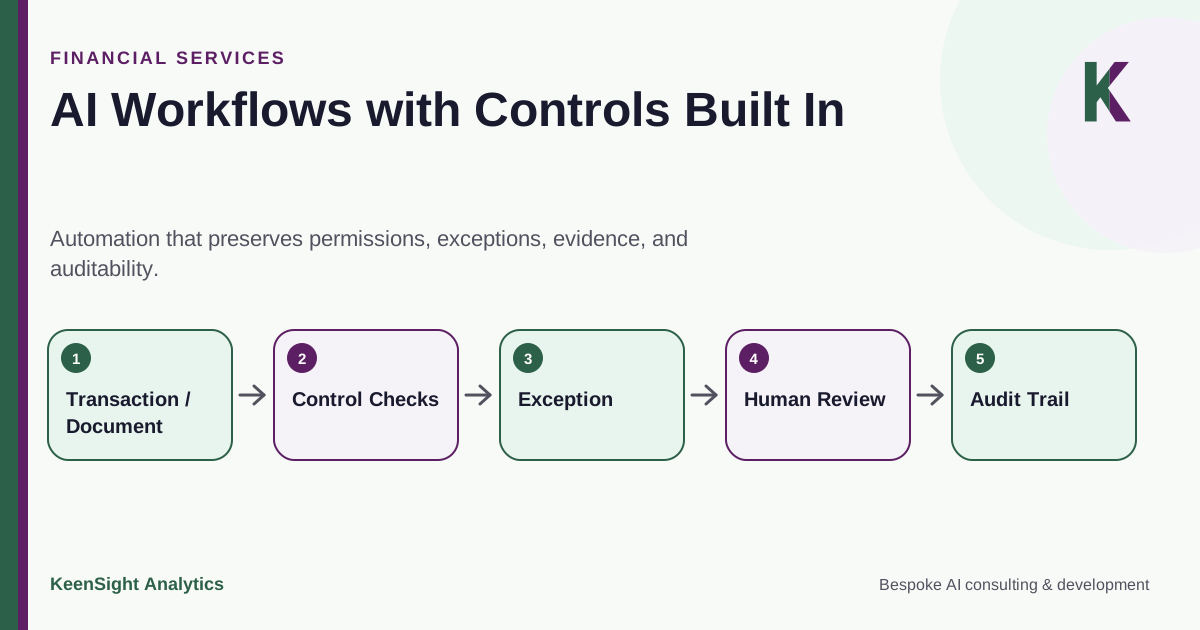
AI Workflows with Controls Built In
Automation that preserves permissions, exceptions, evidence, and auditability.
- Transaction / Document
- Control Checks
- Exception
- Human Review
- Audit Trail
Financial Workflow Opportunities
Apply AI where document volume, repetitive review, and exception handling create operational friction.
Accounts Payable
Extract invoice data, validate configured fields and references, route exceptions, and prepare records for approval or downstream posting.
See the invoice ROI framework →Reporting Support
Assemble recurring inputs, classify commentary, summarize variances, and prepare review-ready reporting packages with traceable source context.
Risk & Control Support
Apply configured rules to identify missing information, unusual conditions, policy exceptions, and items that require escalation to a human reviewer.
Document Intake
Classify statements, forms, contracts, correspondence, and supporting documents and route them into the correct operational workflow.
Exception Management
Create structured queues for unresolved records, missing documentation, reconciliation differences, and other cases requiring investigation.
Enterprise Integrations
Connect AI workflows to ERP, accounting, CRM, document-management, data, and collaboration systems through available APIs and integration patterns.
Controls Before Autonomy
Financial workflows should define what the system may do automatically, what requires a rule or confidence threshold, and what must remain subject to human approval. KeenSight designs those boundaries alongside the data sources, permissions, logging, exception paths, and downstream integrations needed for the specific workflow.
A Practical Delivery Model
Map the Workflow
Identify inputs, systems, business rules, review steps, handoffs, and current failure modes.
Define Controls
Set permissions, validation rules, escalation paths, audit requirements, and human approval points.
Integrate & Test
Connect the required systems and test normal cases, edge cases, permissions, and exception handling.
Operate & Improve
Monitor workflow quality, exceptions, system changes, and operating metrics and refine the solution over time.
Connect workflow controls with AI governance and operating accountability, and prioritize financial-services AI opportunities against value, readiness, and dependencies.
Bring Us a Financial Workflow
We can evaluate where AI fits, where deterministic controls are better, and where human review should remain in the loop.